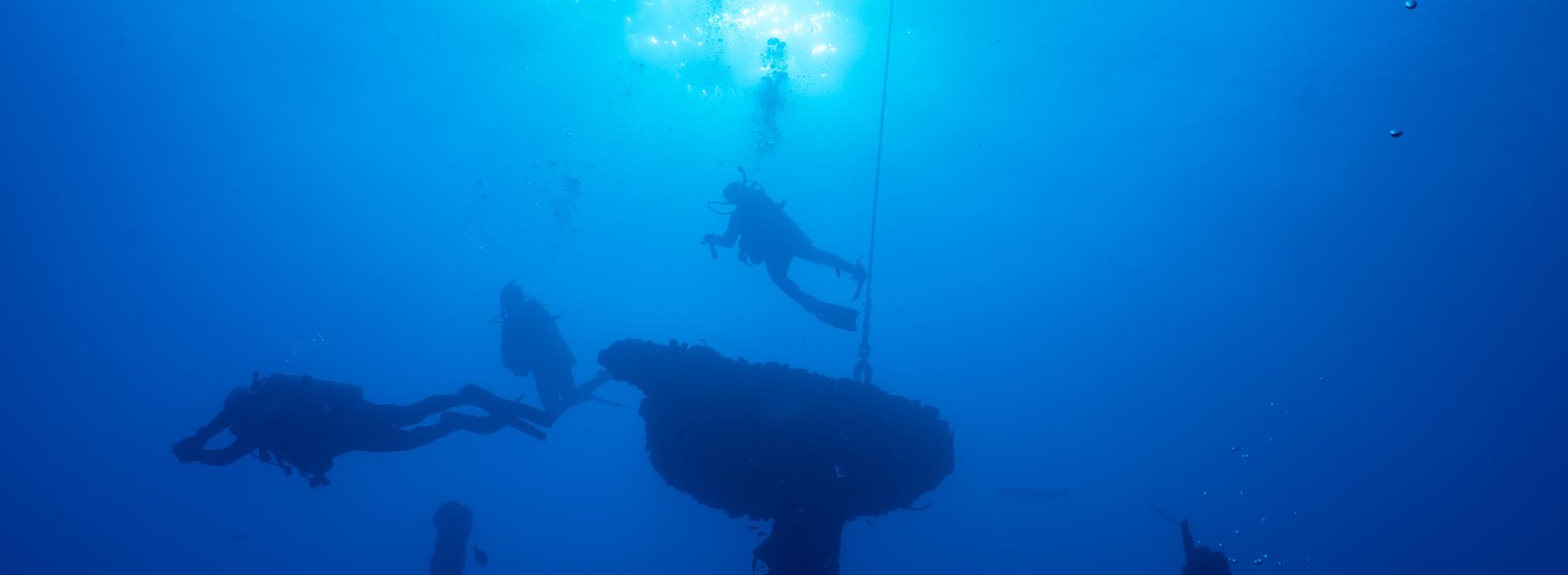
There are dives you remember for the visibility, or the coral, or the sheer depth of the blue around you. And then there are dives where you descend through the water column, settle onto a wreck at 70 feet, and realize you are completely surrounded by sharks.
That's North Carolina.
The stretch of coastline off Morehead City, North Carolina has earned its nickname — the Graveyard of the Atlantic. Hundreds of ships have gone down in these waters over the centuries, many during World War II when German U-boats prowled the Atlantic shipping lanes just off the Carolina coast. What was once a catastrophe has become one of the most remarkable wreck diving destinations in the world.
We dove two of the most storied wrecks in the area — the Aeolus and the Caribsea. Both rest at depths of 70 to 80 feet, accessible from Morehead City, and both offer something that very few dive sites anywhere can match: sand tiger sharks in numbers that have to be seen to be believed.
The Aeolus was a cable laying ship that was deliberately sunk in 1988 to create an artificial reef. At around 80 feet she sits upright and largely intact, providing structure that attracts marine life from across the surrounding water column. When we descended onto her, the shiver was already there — sharks hovering in that slow, effortless way that sand tigers do, barely moving their tails, holding position in the current like they owned the place. Which, of course, they do.
The Caribsea is a different kind of wreck — and a sobering one. She was a merchant freighter torpedoed by a German U-boat in March 1942, just 35 miles off the North Carolina coast. All but six of her crew were lost. She now rests at around 90 feet, broken in sections, heavily encrusted with coral and growth, and home to one of the most impressive concentrations of sand tiger sharks on the East Coast.
Descending onto the Caribsea feels like entering another world. The wreck structure disappears into the distance in both directions, and the sharks are simply everywhere — hovering above the deck, circling the hull, moving slowly through the water between the broken sections.
Between the two dives, we counted somewhere between 25 and 30 sand tigers — a shiver of sharks that made every other dive we'd done that year feel quiet by comparison. That number doesn't fully capture what it felt like. Sand tigers are large sharks — adults typically run six to ten feet — and they have a look about them that commands attention. Their mouths hang slightly open, showing rows of narrow, jagged teeth, which gives them a fearsome appearance entirely at odds with their actual temperament. Sand tigers are docile, slow-moving, and completely uninterested in divers as anything other than mild curiosities.
They proved it on these dives. Some came within two feet of us — not charging, not investigating aggressively, just moving through their space with the unhurried confidence of an animal that has nothing to prove. You hold still. You breathe slowly. You let them pass. And you try to remember to actually look at what's happening instead of just staring in disbelief.
What made these dives especially remarkable was the presence of several juveniles mixed in with the adults — young sand tigers of around three feet, moving through the same water as sharks three times their size. Seeing the size range side by side put the whole encounter in perspective. These wrecks aren't just dive sites. They're habitat. The sharks aren't visiting — they live here.
We've logged dives across the world — the Red Sea, Truk Lagoon, Belize, Cozumel, Bonaire, Roatan, Key West. Every destination has something that makes it worth the trip. North Carolina's answer is this: nowhere else on the East Coast of the United States will you find wreck diving of this quality, this accessible, with this kind of marine life density. The Graveyard of the Atlantic is not a consolation prize for people who can't get to the Caribbean. It's a world-class destination in its own right.
And it's the kind of place that reminds you, every single time you surface, why you learned to dive in the first place.
It starts with certification. Get certified privately with Bob and Kim at RAW Scuba Diving in the DFW Metroplex — all gear included, no hidden fees, no crowded classes.
Get in Touch